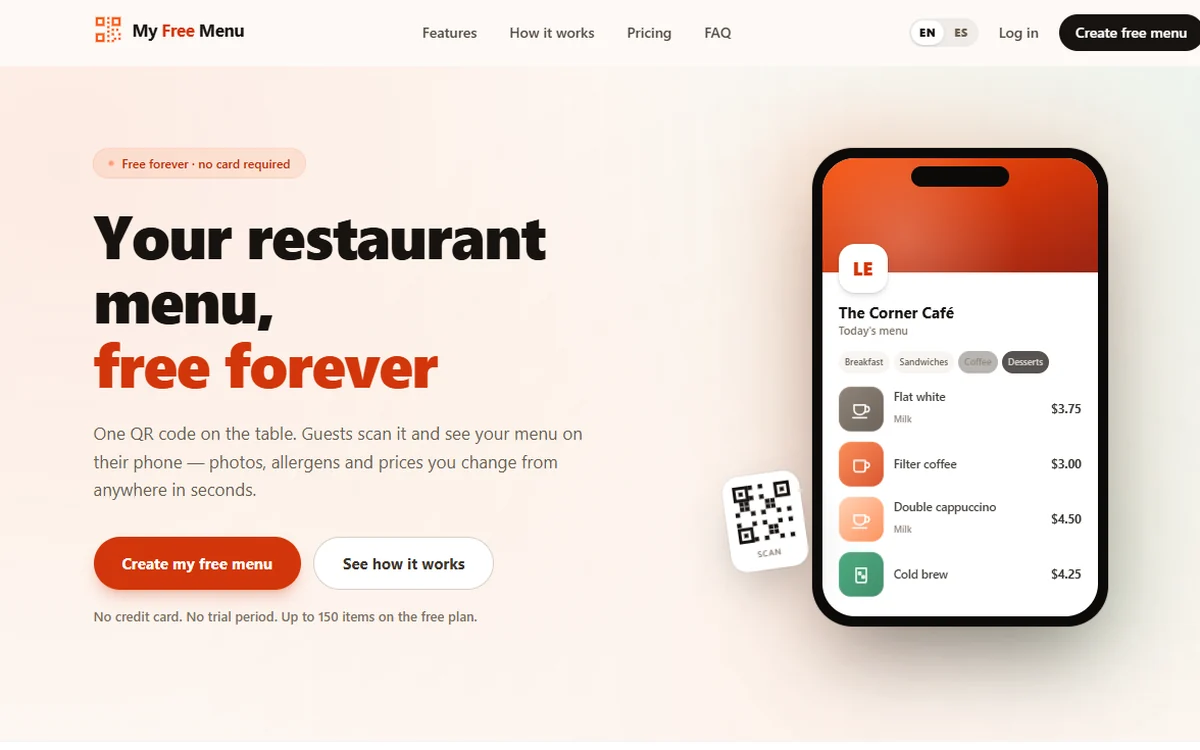
A printed menu is a small, permanent tax on a restaurant. Prices move, a supplier stops delivering, a dish comes off — and every one of those changes costs a trip to the printer. The software that was supposed to fix this mostly made it worse: QR menu apps that are free for a fortnight, then charge more per month than the printing did. My Free Menu is our answer to that, and it is the fourth product we have designed, built and launched end to end.
The Problem
Every restaurant owner we spoke to told a version of the same story. The menu on the table is out of date, and everyone knows it. The corrections live in the waiter’s head: this one is off today, that one is a dollar more now, we stopped doing that in the spring. It works, in the way a notebook works, until a guest orders something that no longer exists and someone has to apologise for it.
The QR menu was supposed to solve this, and for large groups it did. For a café with nine tables it did not. The tools on offer were priced for chains, and the free tiers were trials wearing a different hat — thirty days, then a card, then a monthly bill that made no sense against the cost of reprinting a laminated sheet twice a year. Several of them also put their own branding on the menu, which turns a restaurant’s own table into an advertisement for somebody else’s software.
And under all of it sat a technical problem nobody was treating seriously: the QR code itself. Most generators bind the code to the content, so changing the menu means a new code, which means reprinting the thing the code was supposed to save you from reprinting.
What We Built
My Free Menu is a QR menu for small restaurants where the free plan is the product, not the bait. No card, no trial period, no expiry. Four decisions carry most of the weight:
- The code is permanent, the menu is not. The QR points at the restaurant’s own address, and the menu behind it changes as often as the kitchen does. Print it once, on the table, the window or the paper menu, and never think about it again — even if the dishes change every day.
- Changes land in seconds. Sold out of the special at nine in the evening? Mark it from a phone and it disappears from every table at once. This is the feature that decides whether a QR menu is genuinely better than paper or just more modern.
- Allergens as a first-class field, not a note. The nine major allergens under the FDA’s rules, or the fourteen under the EU’s — the restaurant picks the standard for the country it is in, and the labelling follows. Allergen information written in free text is a liability; written as structured data it is a feature.
- It looks like the restaurant, not like us. Their logo, their colours, their name. A guest scanning a code at the table should see the place they are sitting in.
The part we did not expect to matter as much as it does is the wall screen. The same menu that guests see on their phones can run on a television behind the bar or by the door, in one of eleven designs from a chalkboard to a photo grid, switching itself by the hour so breakfast comes down at 11:30 and lunch goes up without anyone touching it. Two of those screens are included on the free plan, and there is no device to buy.
That screen taught us the most about the environment the product actually lives in. A restaurant’s internet is not a data centre’s internet. It drops. So the screen holds the last menu it received and keeps showing it rather than going black — because a blank television above a bar at seven in the evening is a worse failure than a slightly stale price.
The Stack
The public side is a Next.js application, pre-rendered and served from Cloudflare’s edge, which is what makes the menu open in under a second on restaurant wifi and on a phone with two bars of signal. That number is not vanity. A guest who scans a code and waits four seconds looks up and asks for the paper menu, and the product has failed at the only moment that counts.
Nothing to install was a hard constraint from the start. No app, no account, no cookie banner between a hungry person and the list of dishes. Everything the guest touches is a plain web page, which also means it works on a five-year-old Android as reliably as on a new iPhone — and in a dining room, the oldest phone in the building is the one that decides whether the feature works.
The economics were designed alongside the software rather than bolted on afterwards. Serving a menu costs very little, so the free plan can stay free indefinitely without a subsidy — and paid plans earn their money on things a growing restaurant genuinely wants: analytics, extra screens, several locations under one bill. A free tier only survives if it is cheap to run, which is a product decision long before it is a pricing page.
The Result
My Free Menu is live at myfreemenu.com. The free plan covers one location with up to 150 items, unlimited scans, photos, allergens, the QR code as PNG or SVG, and two wall screens — permanently, without a card. Pro adds analytics, more screens and the removal of our branding for $9 a month; Business runs up to ten locations on a single bill for $24.
It joins QRBranch, HandwashPro and NestSentry as software we own, run and support ourselves. That is deliberate. Building and operating our own products is how we know what we are talking about when we build one for somebody else — including the unglamorous parts, like what a television does when the internet drops.