Animal Reflect is a connect-pairs puzzle: two identical animals disappear when you can draw a line between them. It looks like the kind of game you play without thinking, and for the first twenty levels it is. Then the boards get denser, the timer starts to matter, and you notice that some people clear a board in half the moves you do.
The difference is almost never speed. It is that they understand one rule properly.
The three-line rule, properly
You can connect two matching animals when the path between them is made of no more than three straight lines. Three lines means the path is allowed to turn twice, and no more. Most players read that as “they have to be close together”. They do not. Distance is irrelevant — a tile in the top-left corner can connect to one in the bottom-right if the path between them is clear, because an L-shaped route across the top and down the side is two lines and a single corner.
It is worth being precise about what you are counting, because lines and corners are never the same number. Three lines means two corners. Two lines means one. A straight run is one line and no corners at all. Either way you count it the limit is the same limit: the moment a path needs a third corner it needs a fourth line, and the match is refused.
What actually matters is what the path has to go around. Every obstacle in the way costs you a corner, and you only have two. Two tiles in the same row or column with nothing between them cost none. Two tiles that need the line to step out, travel, and step back cost exactly two — the whole budget, which is why a third thing in the way is what actually kills a match. Once you start seeing the board as “how many corners does this line need” instead of “are these near each other”, the whole thing opens up.
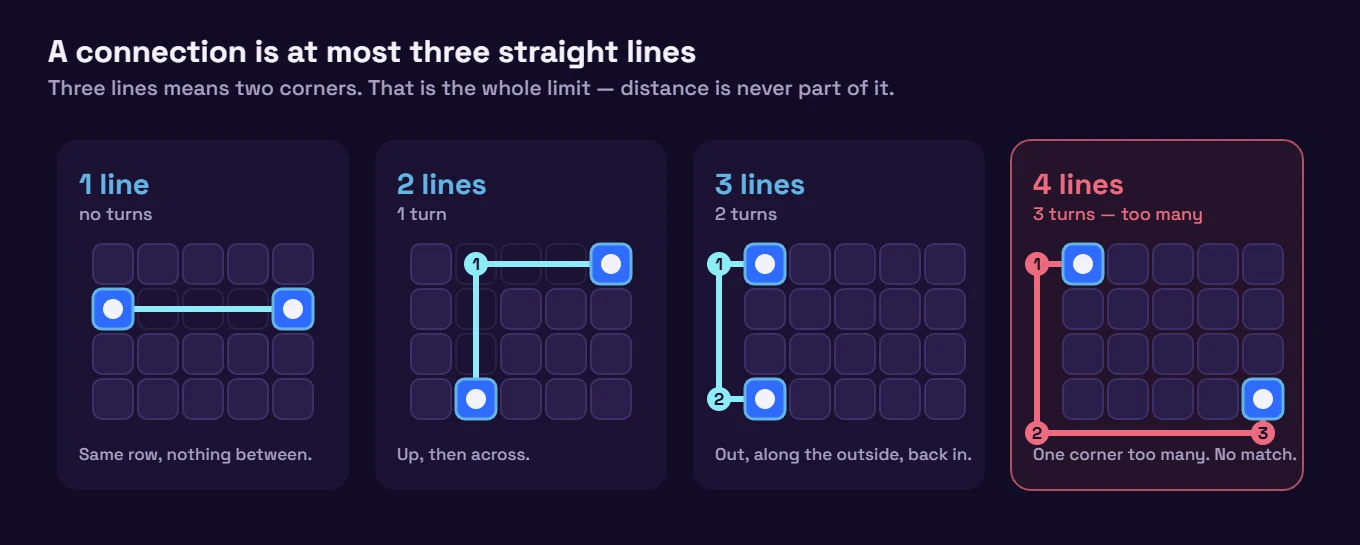
The empty space outside the grid counts too. A line can leave the board, run along the outside and come back in. That is why the tiles on the edges are so much easier to clear than the ones in the middle, and it is the single most useful thing to internalise.
Five things that clear boards faster
- Work the edges first. Edge tiles have the outside of the board available as a route, so they connect in fewer turns. Clearing them also opens corridors through the middle, which makes the next twenty moves cheaper. Starting in the centre does the opposite: it leaves a ring of tiles with nowhere to route around.
- Clear the crowded animal, not the easy one. If one animal has six tiles left and another has two, spend your attention on the six. Pairs with many copies on the board are the ones most likely to end up stranded when the space closes in.
- Count copies before you commit. Every animal appears an even number of times. If you can see three of something, there is a fourth somewhere — and knowing that stops you from clearing the pair that was your only route to the other two.
- Do not clear a pair just because you found it. A match that opens a corridor is worth more than a match that seals one. Before you tap, glance at what the two tiles are currently blocking.
- When you are stuck, look for the tile with the fewest neighbours. Boards rarely deadlock at random. They deadlock around one tile that has been walled in, and finding it usually reveals the move you have been missing.
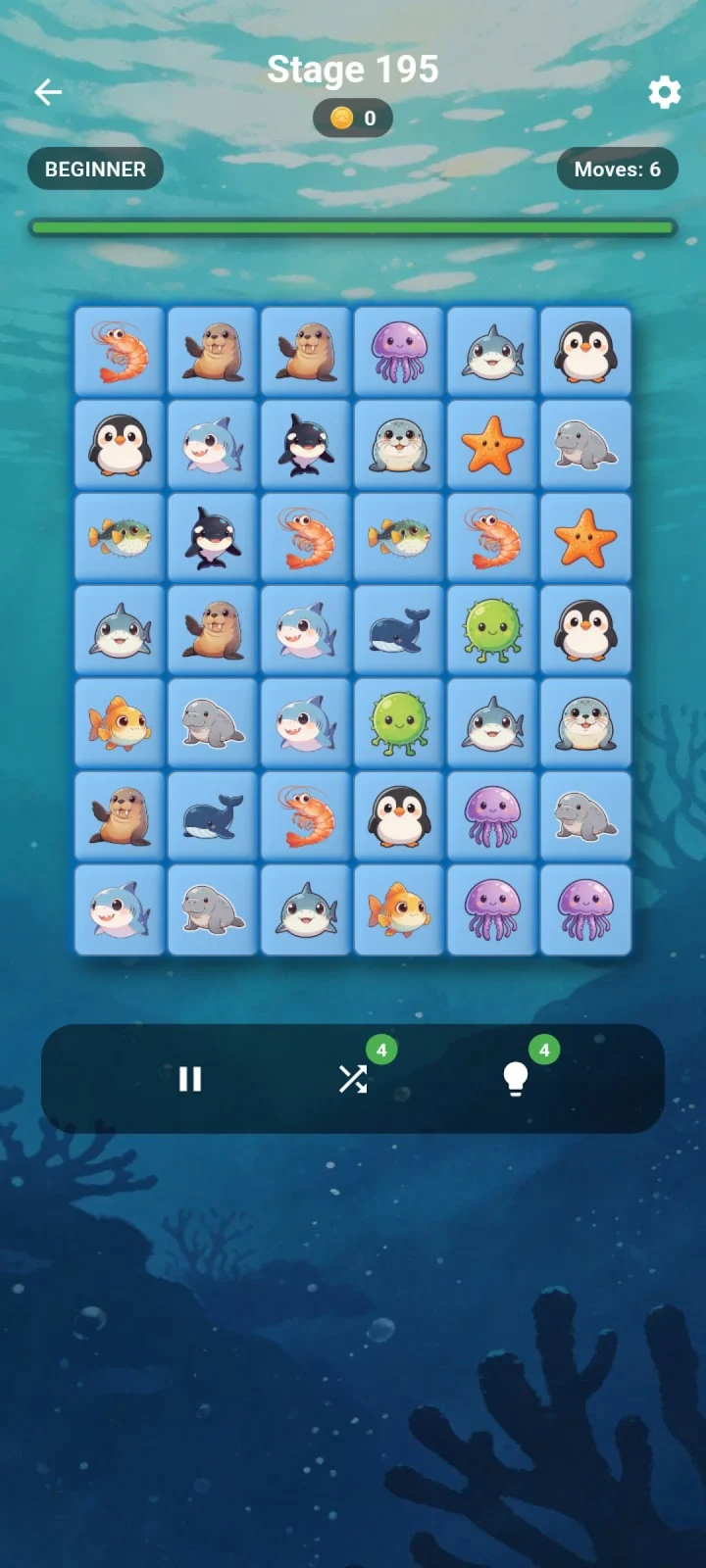
Hints and shuffles: use them earlier than you think
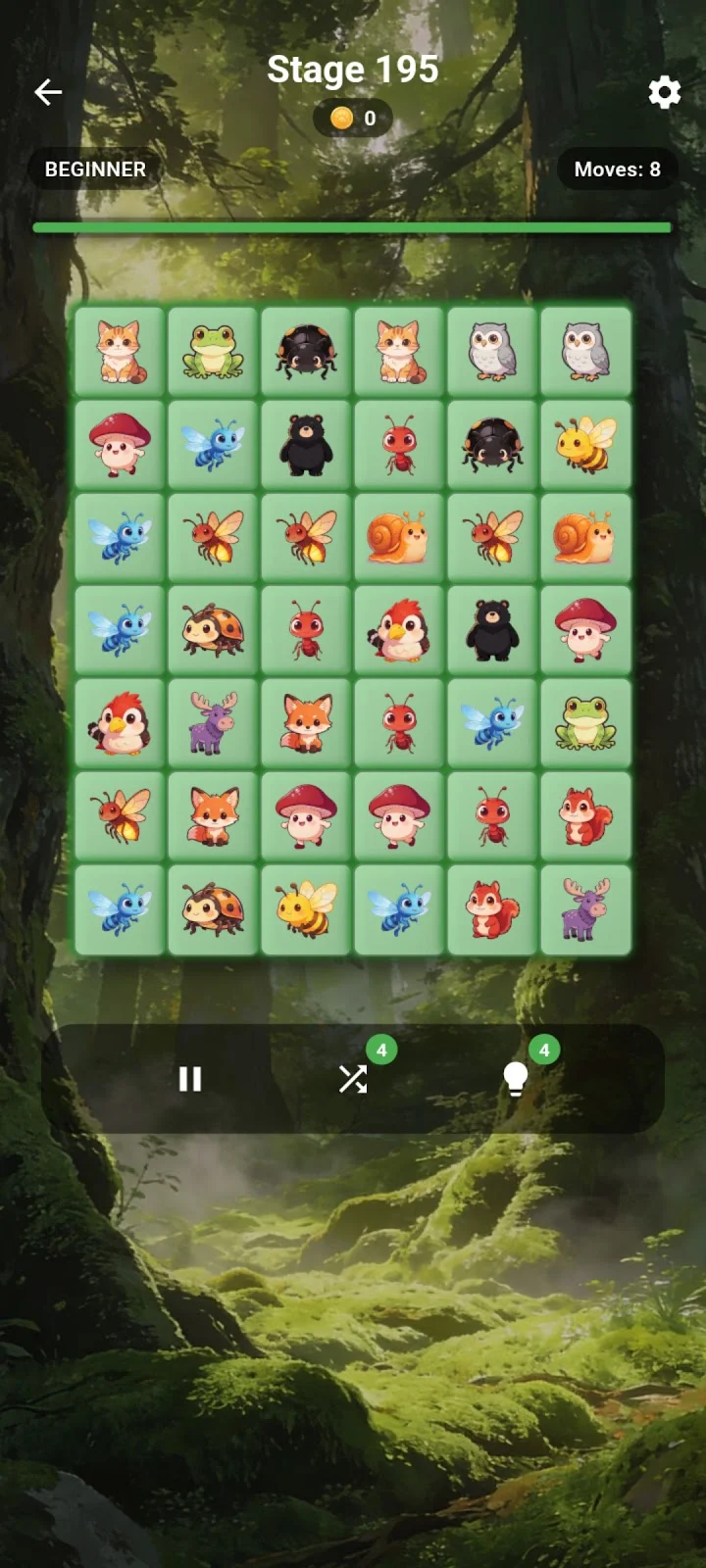
Players hoard hints the way people hoard the good cutlery. But a hint spent thirty seconds into a stall is worth more than a hint spent with four seconds left on the clock, because the first one leaves you time to use what it shows you. A hint is not a confession; it is a way of buying back the time you were about to lose staring at a board.
The shuffle is different. It rearranges what is left, so it is the right tool when the board is genuinely deadlocked and the wrong one when you simply have not spotted the move. If there are still plenty of tiles down there, look once more before you shuffle — you will usually find something, and the shuffle keeps its value for the board that really needs it.
It works with no signal at all
This matters more than it sounds. A lot of puzzle games on Android look free and then stop working the moment you go underground, because the ad has to load before the level does. Animal Reflect runs entirely on the device: an underground train, a plane, a waiting room with hostile wifi — none of it makes a difference.
You do not need an account either. If you do sign in with Google, your progress follows you between devices and you get a place on the global board, but that is a choice rather than a toll gate. You can install it and be playing in the time it takes to unlock your phone.
Where to get it
Animal Reflect is free on Google Play, and it is one of three puzzle games we build and run ourselves — the others are Sudoku Breeze and Build Crush.